Spacetime isn't a material at all
As Popeye used to say, “I’ve had all I can stands, and I can’t stands no more”.
Last night I was watching a science documentary show and they used the analogy of a grid with a ball sitting on top of it, deforming its surface. This analogy is incomplete, it’s misleading and does the beauty of spacetime an injustice.
This was the last straw and I had to turn it off.
Fabric is Conceptually 2-Dimensional
When you hear people say “the fabric of spacetime”, most people think about fabric on spools or being used to make things. A thin sheet of a thing onto which you can place things like boxes or bowling balls or weak comparisons. This is why I’ve never really liked the fabric metaphor. This is a classic example of where a word has specific meaning to a small community but the rest of humanity has a totally different definition.
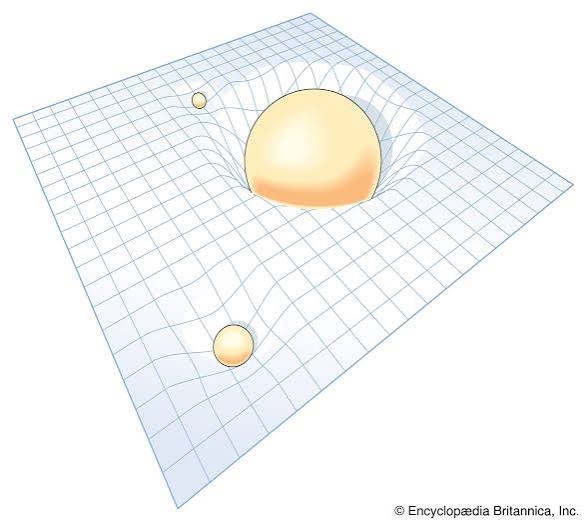
I know the reason for using images like this is to make things more easily understood, but this depiction is just objectively wrong.
The Shape of Spacetime
As our 3 dimensional bodies occupy space, they move forward through time. A 2-dimensional object can move freely within the XY coordinate system. A 3-dimensional object can move freely within the XYZ coordinate system. A person is a 3D object whose worldline1 traces a path through 4D spacetime.
When we imagine a 3D object relative to time, that object isn’t sitting on a spacetime plane, it exists relative to time, the same way an XY object might exist relative to Z.
There aren’t many good ways of describing this reality in a way that can be easily visualized in the mind. This is why the flat fabric holding cannon balls analogy exists. Unfortunately our brains aren’t wired to visualize four-dimensional geometry, so every analogy eventually breaks down.
If you think of yourself standing within a coordinate system and not some physical place, with no resistance to your movement, then that’s “kinda” what spacetime is. Spacetime isn’t a physical substance at all. It’s the geometry that tells the universe how distances and durations are measured (this hurts my head). That’s why asking “what is spacetime made of?” is a little like asking “what is north made of?” It’s treating geometry as though it were a material.
Seeking the Path of Maximal Aging
Awesome. We’ve escaped the analogy of the flat and stretchy fabric. But what about the cannon balls and the force of gravity? How do we get rid of those?
You’re likely familiar with the idea of the “path of least resistance” as the reason why some things travel the way they do. Water takes the path of least resistance, as does lightning. When a lightning bolt is on its way to the ground, it is attempting to follow the path of least resistance or, more useful for my discussion, the path of maximal conductivity.
🗒️ Technically, lightning bolts create many different paths of ionized air and the first one to hit the ground travels back up the winning path. For us programmer nerds, that’s like a tree traversal algorithm. Lightning’s search on the way to the ground is a highly parallel stepped leader algorithm where all the failed paths go away once a winner is found. Fascinating, right?
Then what makes us stick to the planet and fall off of buildings and out of trees (presumably onto an awaiting Newton)? If you said, “the force of gravity”, then you’ve been brainwashed by Big Documentary. That’s what they want you to think and it’s wrong. In Einstein’s theory, gravity isn’t treated as a conventional force. Objects in free fall simply follow the natural straightest possible paths through curved spacetime.
Whenever an object isn’t being acted on by forces other than gravity, it’s in free fall, and it follows the path through spacetime that maximizes its own elapsed time, the path of maximal aging.
In flat space, the shortest distance between two points is a straight line. In warped spacetime, the natural path between two events2 is the path that maximizes experienced time.3
Massive objects warp spacetime. They don’t warp it into anything. There’s no higher-dimensional space that spacetime is sagging into. The geometry itself changes, and that has always been the thing that keeps me up at night.
This warping is not a cannonball on a bedsheet, it is a changing of the geometry. It’s not stretching like rubber or bending because that brings us back to the bad analogy. Think of it like changing the rules of how distance and time are measured. That change affects the path an object will travel.
With nothing else acting on an object in free-fall, it will take a path that produces the experience of the most time. It doesn’t experience more time because of a stretching, it experiences it because the geometry changes in that region. It isn’t even stretching the space between points on a graph’s axis, it’s changing a weighting function for infinitely many intervals.
So next time someone says they fell down, stick it to Big Documentary and tell them that their body traveled the path of maximal aging until other forces acted on it. Trust me, they’ll thank you. Honest.
Here’s another mind-blower: You are not being pulled toward the ground, nor are you constantly falling toward the center of the Earth. The ground is exerting a force that is preventing you from traveling along the path of maximal aging.
Is this Related to Time Advancing Faster in Orbit for GPS?
The GPS satellites are in a state of continuous free-fall. Just like everything else in the universe, they’re traveling forward through time along a geodesic (the natural “straightest” path through spacetime). Another way to think about maximal aging is that you experience more ticks of time relative to something else. If the GPS satellite in orbit is following the maximal aging path, and maximal aging means maximal proper time between two events, then GPS clocks really do tick faster than clocks on Earth’s surface.
So why don’t all the satellites just fall? Their geodesic curves toward the planet. Make it make sense, Kevin! I routinely wake up late at night wondering about this. The satellites are falling along the geodesic, the trick is that the satellite’s geodesic never intersects Earth’s surface because it has enough sideways velocity that the curved spacetime path loops around the planet instead.
Their orbital motion actually slows their clocks slightly through special relativity, but being farther from Earth’s gravity speeds them up even more, so the net result is faster clocks.
Since we’re in a 4D spacetime, we can’t separate motion through space and motion through time. An object’s velocity determines the direction its worldline takes through spacetime, which is totally different than treating time as something that just ticks in the background. The notion of time as background ticks is even harder for us programmers to let go of.
Wrap-up
I am not a scientist or physicist, nor do I play one on TV. I’m just insatiably curious and I never stopped asking questions like “Why is the sky blue?” until I learned about wavelengths of light and refraction. I just hope that this helped at least one person understand things a bit better the next time they see these diagrams.
The analogy of the ball-on-paper illustrates one tiny aspect of curved geometry, but it leaves out the part that actually makes general relativity work: time. Ironically, the famous stretchy sheet isn’t trying to illustrate gravity at all. It’s trying to show geometry. The issue is that viewers like me inevitably interpret the dent as a hole that objects roll into, when Einstein’s genius was that objects aren’t rolling anywhere. They’re simply following the straightest possible paths through a geometry that no longer behaves like the Euclidean geometry we (maybe) learned in school.
The craziest idea Einstein asks us to imagine is this: planets aren’t being pulled around the Sun. They’re trying their hardest to move in perfectly straight lines. The trouble is that in curved spacetime, “straight” doesn’t look anything like what regular Euclidean geometry says is straight.
I do all my own stunts and write all my own prose. AI doesn’t write or even contribute to the prose in my posts.